Hand-tracked ultrasound simulator
Early work on a fetal ultrasound simulator that slices a 3D mesh where a Leap Motion–tracked hand points.
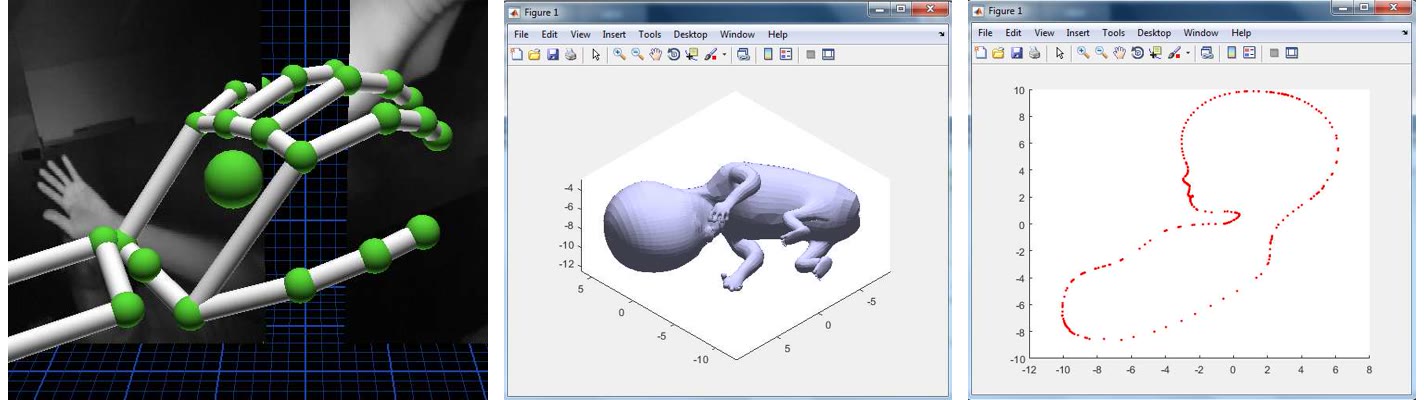
From left: hand tracking from the Leap Motion controller, the fetus mesh in MATLAB, and a cross-section of the mesh, which is what the simulated ultrasound shows.
The goal was an ultrasound simulator for training: as the user moves their hand like an ultrasound probe, the screen shows the matching cross-section of a fetus, the way a real scan would.
- Hand tracking. A Leap Motion controller uses two infrared cameras and three infrared LEDs to track up to two hands, including fingers and joints, within about 2 ft of the device. I read it from MATLAB through the Leap Motion SDK (v2.3.1).
- Anatomy. A fetus mesh with about 79,000 points stands in for the patient, loaded from an STL file. A heart mesh was also used.
- Slicing. A plane is placed through the mesh, and the points where it crosses the mesh’s triangles make up the 2D cross-section on screen.
The first version took about 1.5 s per update. Replacing the exact plane–triangle intersection with a simple distance threshold (keep points close to the plane) brought that to about 1.0 s. That is still too slow for a real-time display, so the next step in the report is a faster slicing algorithm.