3DOF transtibial robotic prosthetic limb
A below-knee robotic prosthesis with a three-degree-of-freedom ankle, spring-based energy recovery and EMG control. ICIAfS 2014.
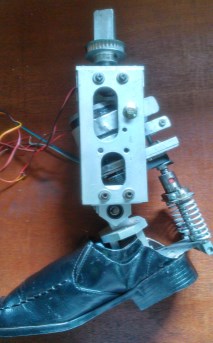
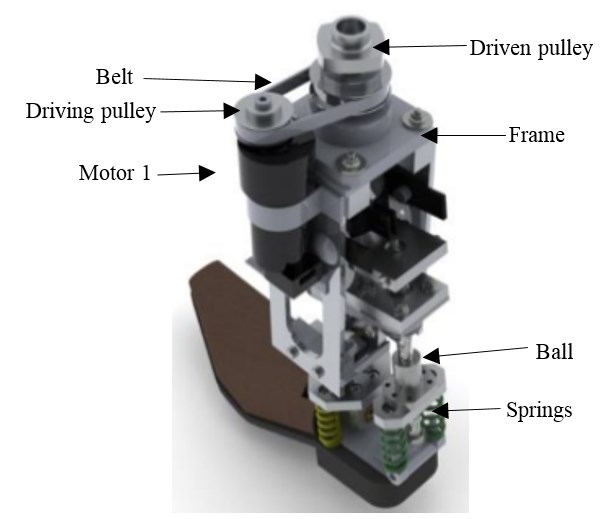
Transtibial (below-knee) amputations are the most common lower-limb amputations, and in Sri Lanka many are caused by land mines and accidents. Most transtibial prostheses actuate the ankle in only one direction, up and down. A real ankle moves in three, and missing the other two leads to an uneven gait. At the University of Moratuwa, our team designed and built a prosthesis with a 3-degree-of-freedom ankle.
Design. Two of the three degrees of freedom are driven by DC motors and the third is passive:
- Dorsiflexion/plantarflexion (foot up/down): a motor turns a ball screw through a toothed belt
- Abduction/adduction (foot rotating in/out): a second motor rotates the frame relative to the stump socket, also through a belt drive
- Inversion/eversion (foot tilting side to side): passive, with two springs that return the foot to neutral
We went through three designs. The first used a worm-and-wheel drive, which was slow. The second used spur gears and a linear actuator, which made the limb heavy and power-hungry. The final design uses belt drives to save weight and trims the aluminium frames based on finite element analysis (minimum factor of safety 3.65). The prototype weighs 3.8 kg.
Energy recovery. The springs compress during plantarflexion and give that energy back during dorsiflexion. We modelled this with a robotic tendon approach and swept the spring stiffness. At 30 kN/m the motor’s peak power for a 70 kg user drops to 83 W, well below the power a natural ankle produces.
Control. We tested two kinds of control:
- Following a healthy leg: a potentiometer worn on a healthy leg gave the target angle, and a PD controller on an Arduino tracked it. This was tested with three subjects.
- EMG control: surface EMG from the tibialis anterior and gastrocnemius, sampled at 2 kHz through a NI DAQ card and LabVIEW, drove the up/down motion from the difference of the two muscles’ RMS activity.
In both experiments the prosthesis followed the natural limb. Abduction/adduction and inversion/eversion reached close to natural ranges. Dorsiflexion/plantarflexion reached 12°/32° against the natural 20°/50°, which is still enough for daily activities.
- Demo video: 3DOF prosthetic limb on YouTube
Papers
- A 3DOF transtibial robotic prosthetic limb (ICIAfS 2014) (PDF)
- A review on hybrid myoelectric control systems for upper limb prosthesis (MERCon 2015)